
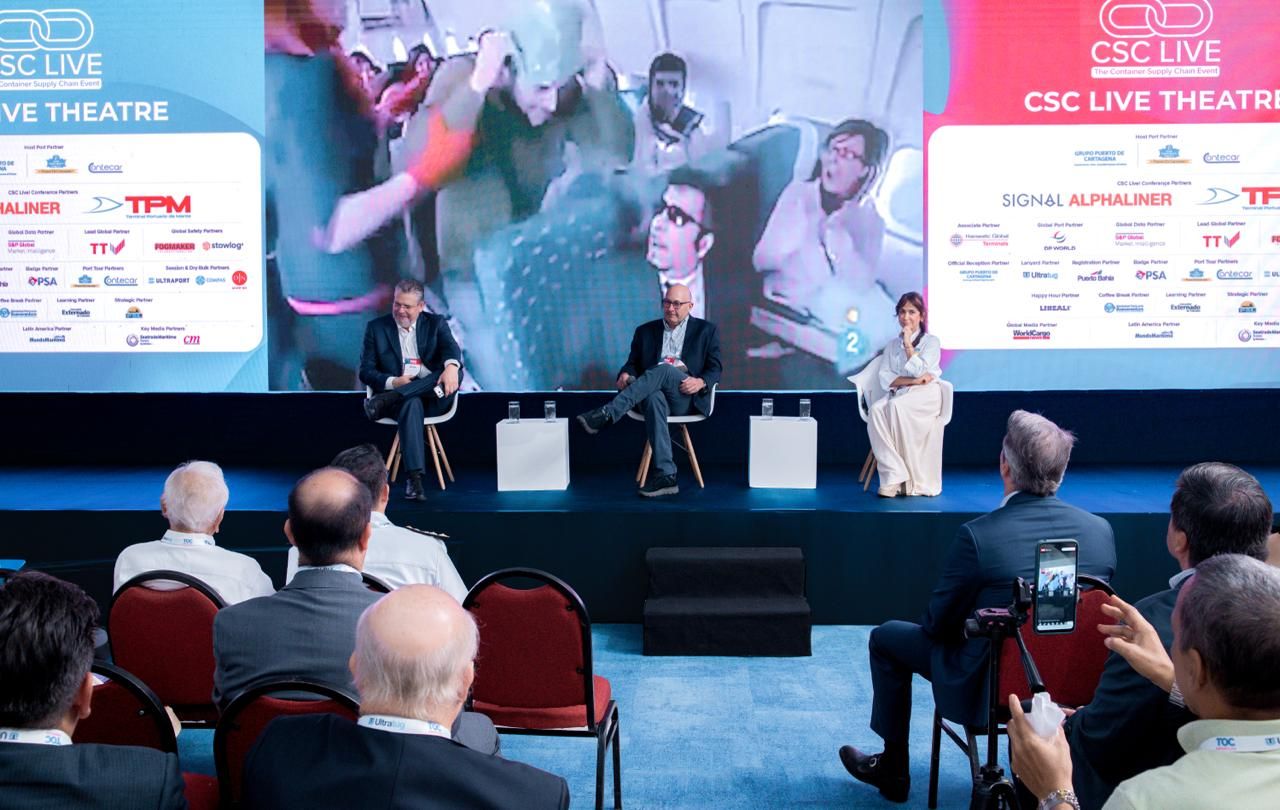
Grupo Puerto de Cartagena’s commercial lead and its head of talent told delegates at a panel titled “From Colombia to the world”, moderated by Carlos José González España of Multimodal Consulting, that the next competitive edge for ports will rest less on cranes and berths than on how well people and artificial intelligence are organised to absorb constant disruption.
Giovanni Benedetti, Grupo Puerto de Cartagena (GPC)
Benedetti, the port’s commercial lead, said the industry has never dealt with so many disruptions at once. “I think the maritime port industry has never before suffered so many geopolitical disruptions, tariffs, climate, and so on,” he said, adding that ocean carrier schedule reliability now stands at just 27%, even as ships and terminal technology have both improved.
He said there is no single answer for every customer: carriers want punctual vessels and full container counts, cargo owners want nothing stolen or missing, and everyone wants it cheaper, in an industry that is capital-intensive on both the port and shipping sides. Citing US President Trump’s estimate that keeping the Strait of Hormuz open would cost $2m a day, Benedetti said geopolitical risk now feeds directly into cost across the port and shipping chain. GPC’s answer, he said, rests on three pillars: “We try to work on three pillars… knowing how to anticipate, knowing how to adapt and above all collaborating with all the actors.”
Artificial intelligence, Benedetti said, does not replace commercial or port experience or human relationships, it complements them. “Tomorrow, port competitiveness won’t be about who has the best infrastructure, it will be about who makes the best use of artificial intelligence resources to make it more efficient, more transparent, more visible, more predictable,” he said.
Karina Kure, Grupo Puerto de Cartagena (GPC)
Kure, who leads talent at GPC, framed the same disruption through a World Economic Forum model of converging forces: geopolitical fragmentation, technological disruption, climate change, social and demographic strain, and economic uncertainty. “I particularly like a model used by the World Economic Forum that tells us: what is happening today isn’t isolated forces, but forces that are converging, amplifying each other and even turning what would be a change into a change of system,” she said.
Her answer is organisational rather than predictive: build the capacity to decide with incomplete information instead of chasing perfect forecasts. “We can’t control uncertainty, but we can control how we prepare to navigate it,” she said. GPC runs its AI adoption through a four-step model, educate, equip, experiment and scale, alongside continuous upskilling, reskilling and cross-skilling, she said, with training treated as a corporate responsibility and learning as an individual one.
Kure said agentic AI has already changed what counts as a workforce, giving a single analyst the leverage once needed from a team of twenty. She argued juniors will not lose the chance to develop, they will simply learn alongside AI from the outset, as will every level of the organisation. The gap AI creates, she said, will not be closed by machines. “The most successful organisations won’t be those with the most artificial intelligence, but those with more people who are prepared and have greater judgement to direct artificial intelligence,” she said.