
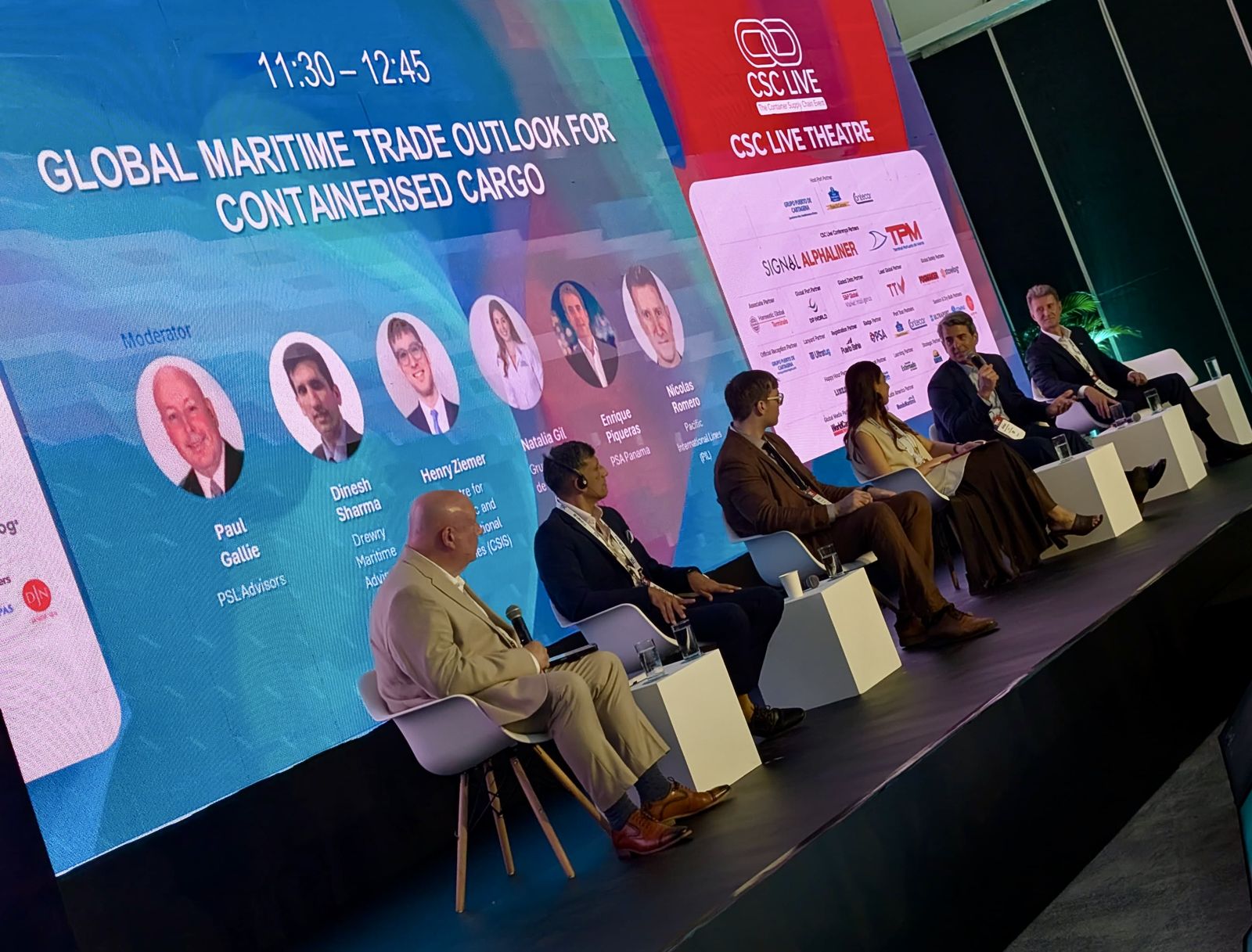
Dinesh Sharma, director at Drewry Maritime Advisory, told delegates that global laden cargo volumes are running about 10% below where disruption-era trends had pointed. His data opened a session in which four other panellists offered their own read on the same uncertainty: a geopolitical analyst, a port economist, a terminal operator and a carrier.
Dinesh Sharma, Drewry Maritime Advisors
Sharma set out the gap between expected and actual trade growth since 2018: global laden volumes are around 10% below where they would have been, and total port throughput is about 5% lower, with transshipment hubs growing roughly 6% a year against 3% at gateway ports and 1.5% for the underlying economy. In Latin America he put the shortfall at 2–3% against pre-2018 expectations, driven in part by retailer inventory levels that remain about 10% below where they stood before the uncertainty began. “We’re sitting roughly around 10% lower in terms of global cargo volumes moving,” he said.
Henry Ziemer, Centre for Strategic and International Studies (CSIS)
Ziemer, of the Washington-based CSIS, argued that the Americas are becoming a geopolitical hedge as conflicts in the Middle East and Europe, and fears over the Indo-Pacific, push the world towards the region’s energy, critical minerals, agriculture and value-added manufacturing. He pointed to Guatemala, where a new national courts law and a US Army Corps of Engineers project to modernise Puerto Quetzal were among the positive signs of US engagement. But he warned that the rising strategic attention carries a cost. “Who controls ports and maritime infrastructure matters now more than ever,” he said.
Natalia Gil, Grupo Puerto de Cartagena (GPC)
Gil, an economic investigations leader at Grupo Puerto de Cartagena, said a study the port’s research team ran covering 2023 to 2026 found that a shipping line changes a route, a service or a parameter of a service on average every 3.9 days, a pace that makes capacity alone an unreliable measure of readiness. She argued that connectivity and operational and commercial flexibility, rather than infrastructure spending alone, were what let Cartagena add new services even during five quarters of major disruption from the Panama Canal drought, the Strait of Hormuz and the Suez Canal. “A shipping line, on average, changes its route, changes a service, or changes a parameter of that service every 3.9 days,” she said.
Enrique Piqueras, PSA Panama
Piqueras, chief executive of PSA Panama, said planning capacity on past volume averages no longer works now that carrier networks and trade routes shift so fast, and that flexibility has to be designed into capacity planning in the same way as infrastructure. He described PSA’s top priority through to 2030 as what he called “brain capital and culture”, ahead of physical expansion and connectivity, arguing that people, not equipment, determine how far a terminal can leverage new technology. “Technology is bought, but culture is built,” he said.
Nicolas Romero, Pacific International Lines (PIL)
Romero, regional head for Latin America at Pacific International Lines, said he takes a more positive view of trade in Guyana and the rest of South America than the wider uncertainty might suggest, pointing to export patterns shifting towards more transformed commodities and countries diversifying their trading partners. He said PIL designs vessels specifically for the region, wide-beam, shallow-draft ships carrying heavy reefer volumes, to work within existing port and depth constraints rather than wait for infrastructure to catch up. “We continue to believe in the growth of economies,” he said.