
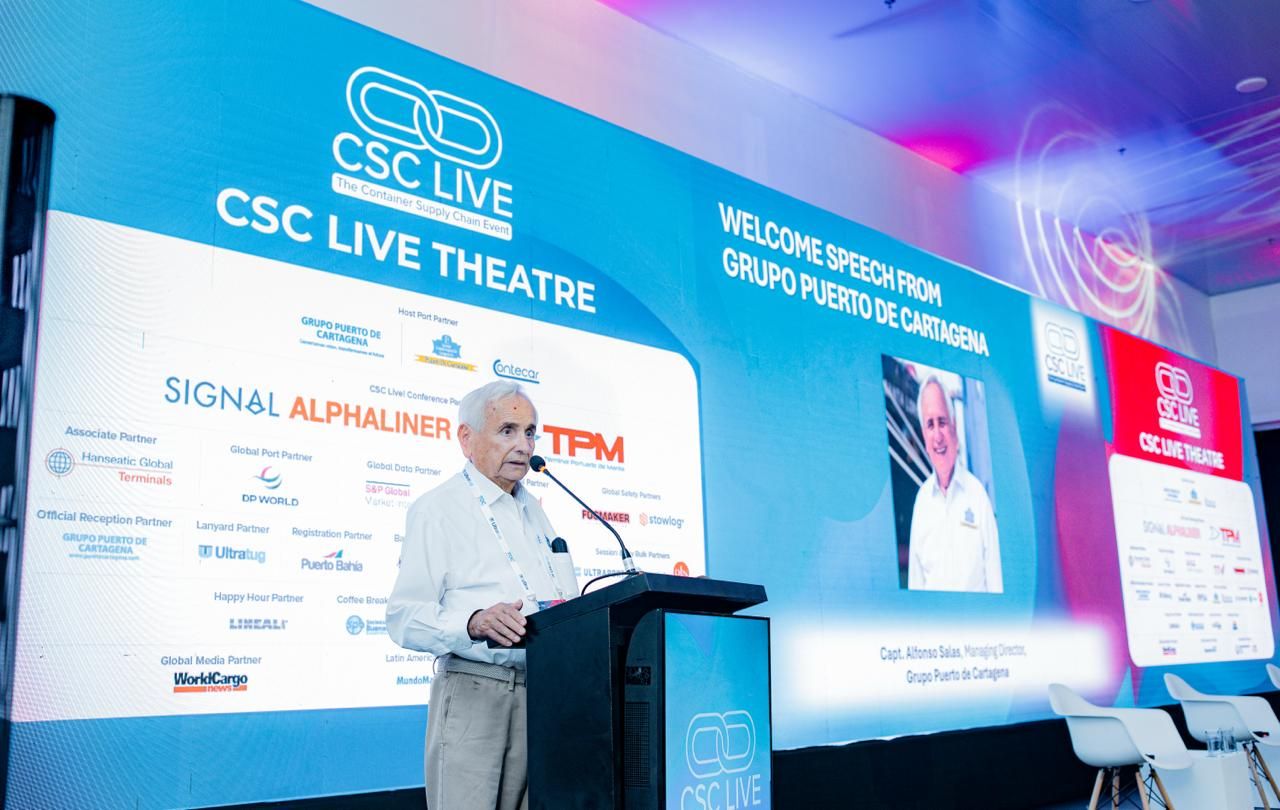
Colombia’s new port modernisation decree extends terminal concession periods but ties the extensions to continued performance, Alfonso Salas, of Grupo Puerto de Cartagena (GPC), told delegates at the opening of TOC Americas in Cartagena.
“This law strengthens legal certainty, sets conditions for our ports to keep investing, modernising our infrastructure and improving our competitiveness, but it also sets us a responsibility: to maintain high standards of efficiency, productivity and quality of service throughout the life of our concessions,” Salas said.
The decree is also designed to make long extensions to concessions the default so that investment does not stall, provided ports maintain their performance record, Salas said.
GPC expects to move a little more than 5 million containers this year, Salas said. This year’s event is the third time TOC Americas has been held in Cartagena, after editions in 2014 and 2019, he added.
Salas said the industry had endured a pandemic and conflicts that altered shipping routes since GPC last hosted the event in 2019.
Opening the session, Mateo Wiegold of TOC Worldwide set the theme for the conference as “Trade, conflicts and disconnection,” before asking delegates where the industry’s growth would come from. He said the event had been organised around three themed days: maritime trade and the supply chain; port growth and sustainability; and a regional day focused on the ports of the Greater Caribbean.
Volume was not the only measure of a port’s value, Salas argued. “A port should not be measured only by the number of containers it moves. It must also show what trade it enables, how many markets it connects, how many routes it makes possible, with what frequency, with what continuity, with what freight rates, what capacity it offers to keep a chain running when a route changes,” he said.
Salas added that the chain’s ability to adapt mattered more than predicting where that growth would happen. “We don’t know where the next shift in our business will happen, but what we can say is that we have the physical channel ready,” he said.
He closed the welcome address by telling delegates: “Welcome to Cartagena, welcome to Colombia, welcome to TOC Americas 2026.”