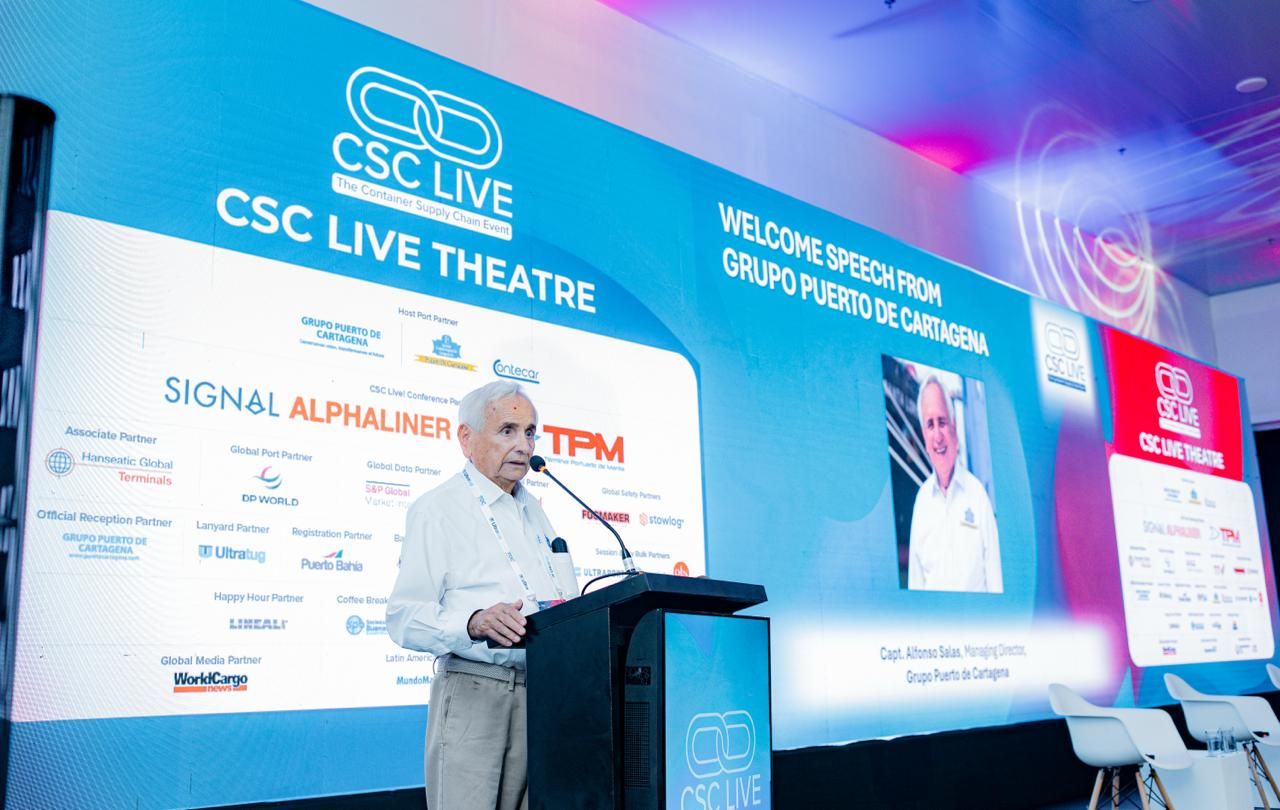
A port should not be judged only by how many containers cross its dock, Alfonso Salas, of Grupo Puerto de Cartagena (GPC), told delegates at the opening of TOC Americas 2026 in Cartagena. Its real value, he said, lies in the markets it connects, the routes it keeps running and its ability to hold a supply chain together when one of those routes changes.
Mateo Wiegold, of TOC Worldwide, opened the conference by framing this year's theme as a single question: trade, conflict and disconnection, and where the industry grows from here?. Salas's answer was that the question of growth cannot be separated from how a port's performance is actually measured.
Salas made the point as the conference returned to his city for a third time. “This is the third time TOC Americas has gathered here,” he said, recalling editions in 2014 and 2019. At the last edition, he said, delegates were discussing digital transformation, automation, connectivity and protectionism, and many of those same subjects remain on the agenda seven years later. Since then, he said, the industry has also had to work through a pandemic, conflicts that rerouted maritime trade and restrictions affecting access to Colombia's shipping channels.
How does Salas define a port's value?
Rather than a single figure, Salas set out a list of measures he said should replace volume alone. A port's worth, he argued, should be read in “how many markets it connects, how many routes it makes possible, with what frequency, with what continuity, with what freight rates, what capacity it offers to keep a chain running when a route changes.” Cartagena's own throughput, he said, is not the point in itself: “In 2026 we will move a little more than 5 million containers,” he said, but the figure only matters alongside the connectivity built up behind it.
Salas said the port could not predict where its next period of growth would come from, but argued that Cartagena had the infrastructure in place to adapt when a trade route shifted, rather than waiting to react once it had already happened.
Why does it matter now?
Colombia's national government has just issued a new port modernisation decree, Salas said, and it ties the question of how a port is judged directly to how long it keeps its concession. “This law strengthens legal certainty, establishes conditions so our ports can keep investing, modernising our infrastructure and improving our competitiveness, but it also sets us a responsibility: to maintain high standards of efficiency, productivity and quality of service,” he said. Future extensions to port concessions, he said, will take into account a port's performance and its ability to guarantee the continuity of the services it provides, rather than the volume it handles on its own.
What happens over the next three days?
TOC Americas 2026 is structured around that same question, Mateo Wiegold, of TOC Worldwide, told delegates as he opened the conference. The programme has been split into three themed days to work through it in turn. “The first day, which focuses on maritime trade and the logistics chain. The second day, focused on port growth and sustainability. And the third day, the regional day, where we will take a close look at the ports of the Greater Caribbean,” he said.