
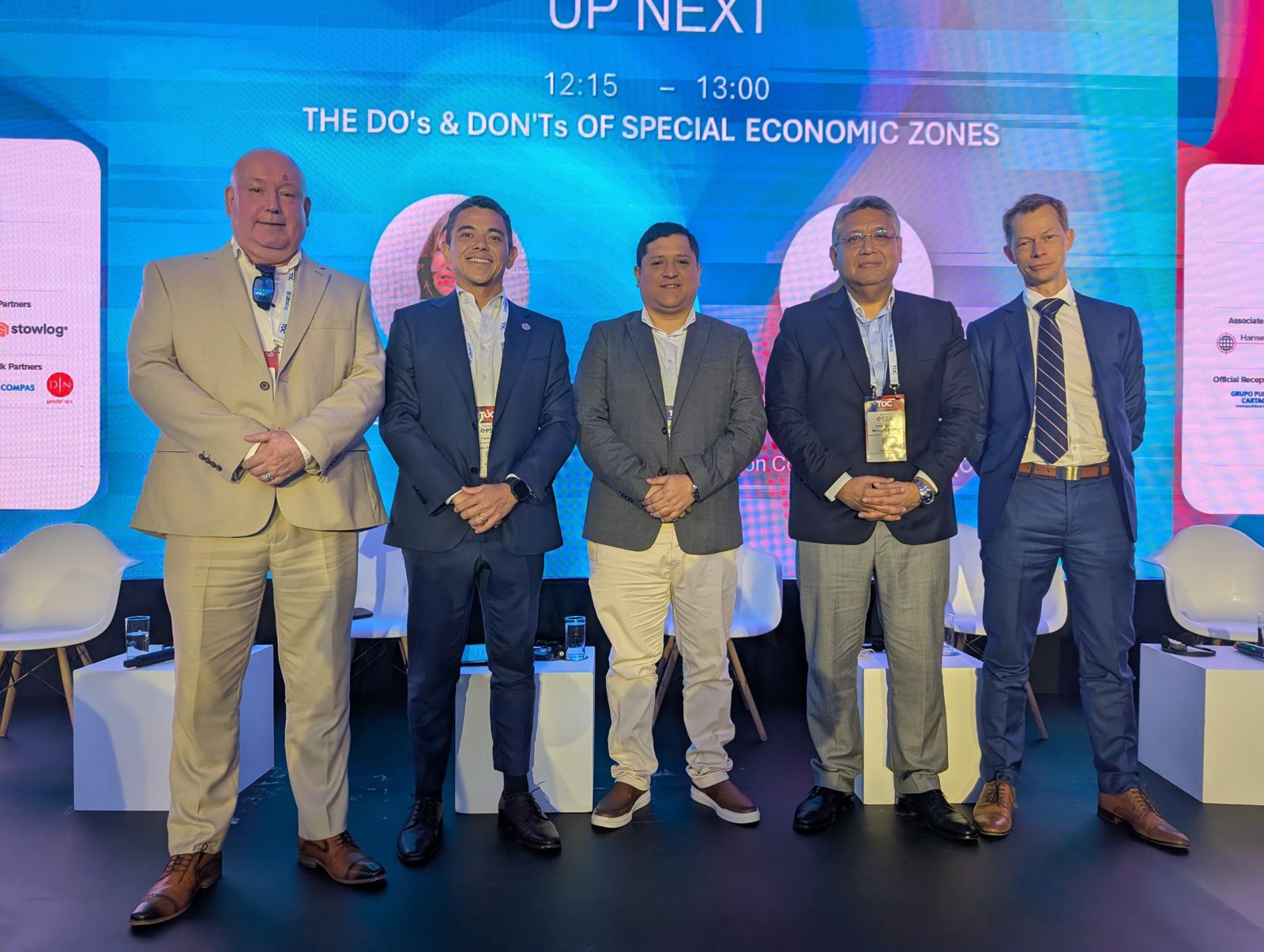
Terminals that perform well inside the gate can still fail outside it, Paulo Ruy of Hanseatic Global Terminals told delegates at TOC Americas in Cartagena, opening a panel on what connects ports to their hinterland. Three more panellists, from Colombia, Peru and North America, built on the point with their own figures and examples.
Paulo Ruy, Hanseatic Global Terminals
Senior vice-president commercial for Latin America Ruy said that after moving from buying ocean capacity at a carrier to selling capacity at a terminal operator, he realised a port’s value could not be measured by fleet size and crane productivity alone. Access roads, connectivity and the ability to move cargo out mattered just as much as dwell time and truck turnaround inside the gate, he said. He pointed to reefer warehouses close to terminals in Chile’s eighth region and rail links feeding the port of Paranaguá as examples of infrastructure beyond the terminal itself. “I don’t know if we could build together with some port authorities, dashboards that take into account all these variables that would make it easier for us to take decisions and make sure that our customers are actually getting what they need,” he said.
Victor Carrasco, COMPAS
Port manager Carrasco said terminal indicators need to create value for customers and justify future investment, and that those figures should be shared with authorities and clients as part of the operating cycle. Rather than always adding berths or equipment, he argued operators should focus on getting more from the infrastructure already in place, through technology, people and better processes. A second generation of concessions, he said, depends less on new assets than on trained staff and a readiness to think differently, urging terminals to stop thinking “we have always done it this way” and move towards multimodal operations. “We can always do more with less,” he said.
Tom van Eynde, TiL Group (MSC Group)
Managing director for North America van Eynde said reliable connectivity outside the terminal gate matters as much to an investor as the infrastructure inside it, with North America standing out for its reliance on rail. Some TiL terminals move close to 40% of cargo by rail, he said, and in Colombia the group handles roughly half a million boxes by rail a year, with one asset managing around 50,000 a week in its busiest periods. That dependence cuts both ways, he said, because capacity also rests on rail operators supplying enough railcars, particularly when volumes are diverted from a strike-hit port to another terminal. “Rail is always the magical solution, of course, that gets all that cargo off the roads for commercial congestion,” he said.
Jorge Chávez, Autoridad Portuaria Nacional del Perú
Managing director Chávez said Peru’s port system had moved through four phases, from state-run terminals before 2000 to today’s privately financed developments, with investment now running through three channels: public-private partnerships worth about $1.4–1.5bn, private investment under the national port law, and public spending, taking the country’s overall port development portfolio to around $9bn. He pointed to Chancay, a privately owned but publicly used port, which has invested about $1.3bn in the first of four planned phases, and to APM Terminals’ roughly $600m expansion of Callao’s Muelle 5, the terminal handling 80–85% of the cargo that moves through Peru. With some concessions approaching the end of their 30-year terms, he said Peru had passed a new law allowing extensions of up to 30 more years tied to fresh investment, including a plan to roughly double capacity and build a dedicated route for truck traffic to ease congestion on Callao’s access roads. “We cannot forget the environment in which we also live,” he said.