
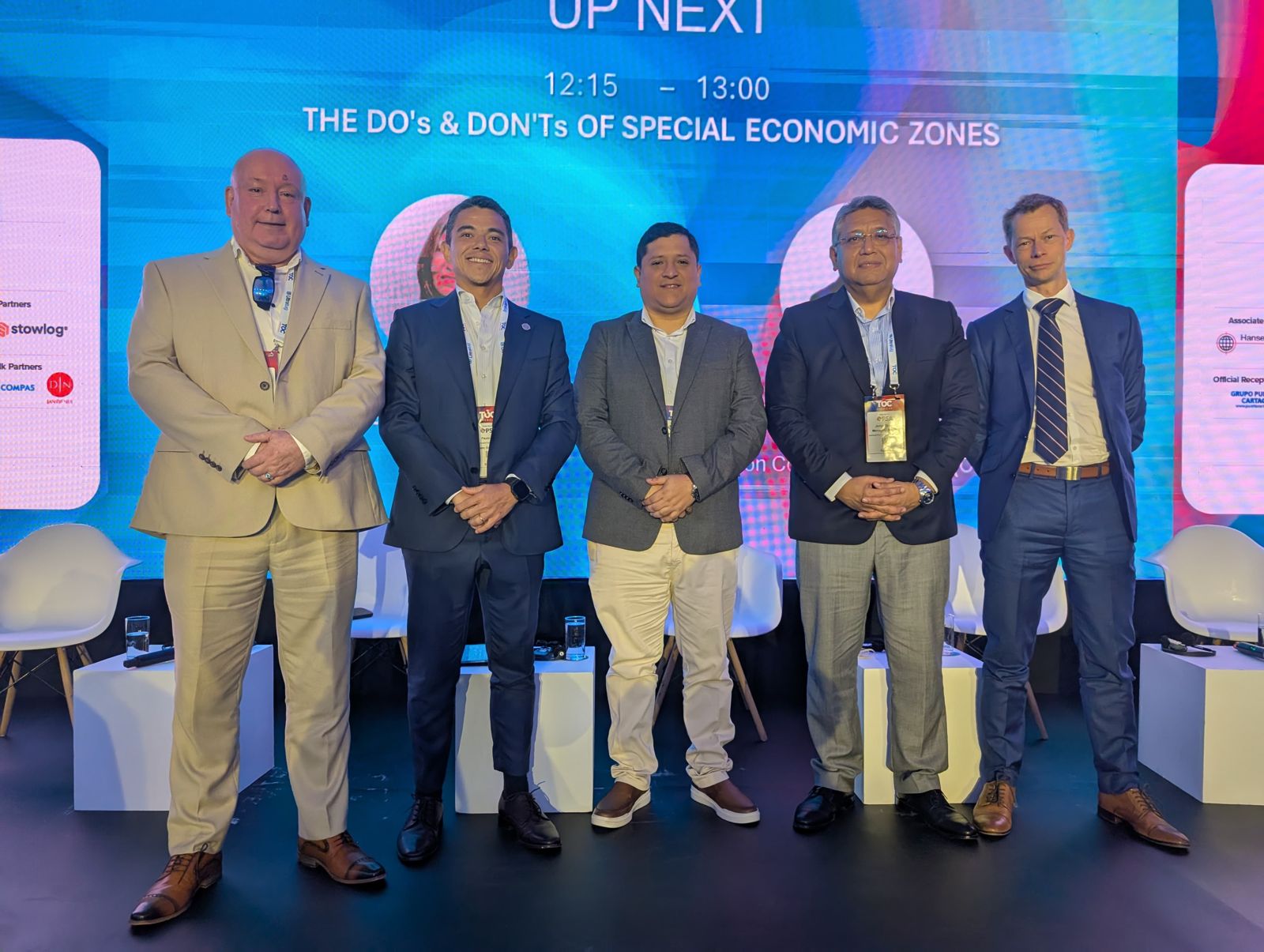
A port’s value comes from using the infrastructure it already has more effectively, not simply from building more berths or cranes, Víctor Carrasco, port manager at COMPAS in Colombia, told delegates at TOC Americas 2026 in Cartagena. “We can always do more with less,” he said.
Building the ecosystem
Paulo Ruy, senior vice-president commercial for Latin America at Hanseatic Global Terminals, said he reached a similar conclusion from the other side of the business. Buying ship capacity at a carrier, he said, the measures that mattered most were fleet size and terminal performance. Once he moved to selling capacity for a terminal operator, the picture changed. “We need to look a lot broader than that. We need to look at the access roads, we need to look at the connectivity, we need to look at what are the possibilities of getting that cargo out,” he said, pointing to reefer warehouses and depots close to terminals in Chile’s eighth region, and to rail connectivity at Paranaguá that lets reefer cargo leave the port by train rather than road.
Rail plays the same role further north. Tom van Eynde, managing director for North America at TiL Group, part of the MSC Group, said some of its terminals move close to 40% of their cargo by rail, and the group’s Colombia terminal handles roughly half a million boxes a year that way. Owning the rail spur inside the fence is not enough on its own, he said. “There’s also a matter of not just making sure that your infrastructure is there within your walls, outside of your walls, but also make sure that you’ve got a reliable partner to provide you with the equipment that powers loading,” van Eynde said.
Jorge Chávez, managing director of Peru’s National Port Authority (Autoridad Portuaria Nacional del Perú, APN), described the same logic as a chain with four links: the productive zone that generates the cargo, the land connectivity that moves it, the port terminal itself, and the shipping route out. “What we are doing is looking at this as an ecosystem,” he said, warning that channelling more investment into terminals alone, without the links around them, would only deepen the imbalance.
Why squeeze, not build
Carrasco said the industry’s instinct to add concrete is often the wrong one. He said: “We also need to think about how to really squeeze the juice out of the infrastructure that each terminal already has. It isn’t only about more berths, more machines, but about how to benefit the market with what we have, how to be efficient through technology, through people.”
Chávez gave Callao as the live case. The port moves about 80–85% of Peru’s cargo, he said, and APM Terminals is working through a $600m phase of its concession investment programme there. But the constraint today, he said, is no longer capacity at the quay: it is the single road serving terminals that sit side by side, which backs trucks up for kilometres. Carrasco said the mindset has to change before the infrastructure does. “It’s necessary for terminals to drop that familiar phrase: ‘that’s how we’ve always done it,’” he said, adding that terminals need to start thinking in multimodal terms.
What’s next
Peru already has a legal route to act on it, Chávez said. A new law passed by Congress allows port concessions to be extended by up to 30 years in exchange for further investment, and operators are starting to use it. The DPO concession at Callao runs to 2036, he said, and its operator has proposed an extension that includes a dedicated truck viaduct to the port and what Chávez described as a holding area for trucks waiting to enter the terminals. Transportadora Callao, a fishmeal export terminal whose concession ends in 2031, has already filed its own extension plan. The operator of Paita, on Peru’s north coast, is preparing to present a plan of its own, Chávez said.