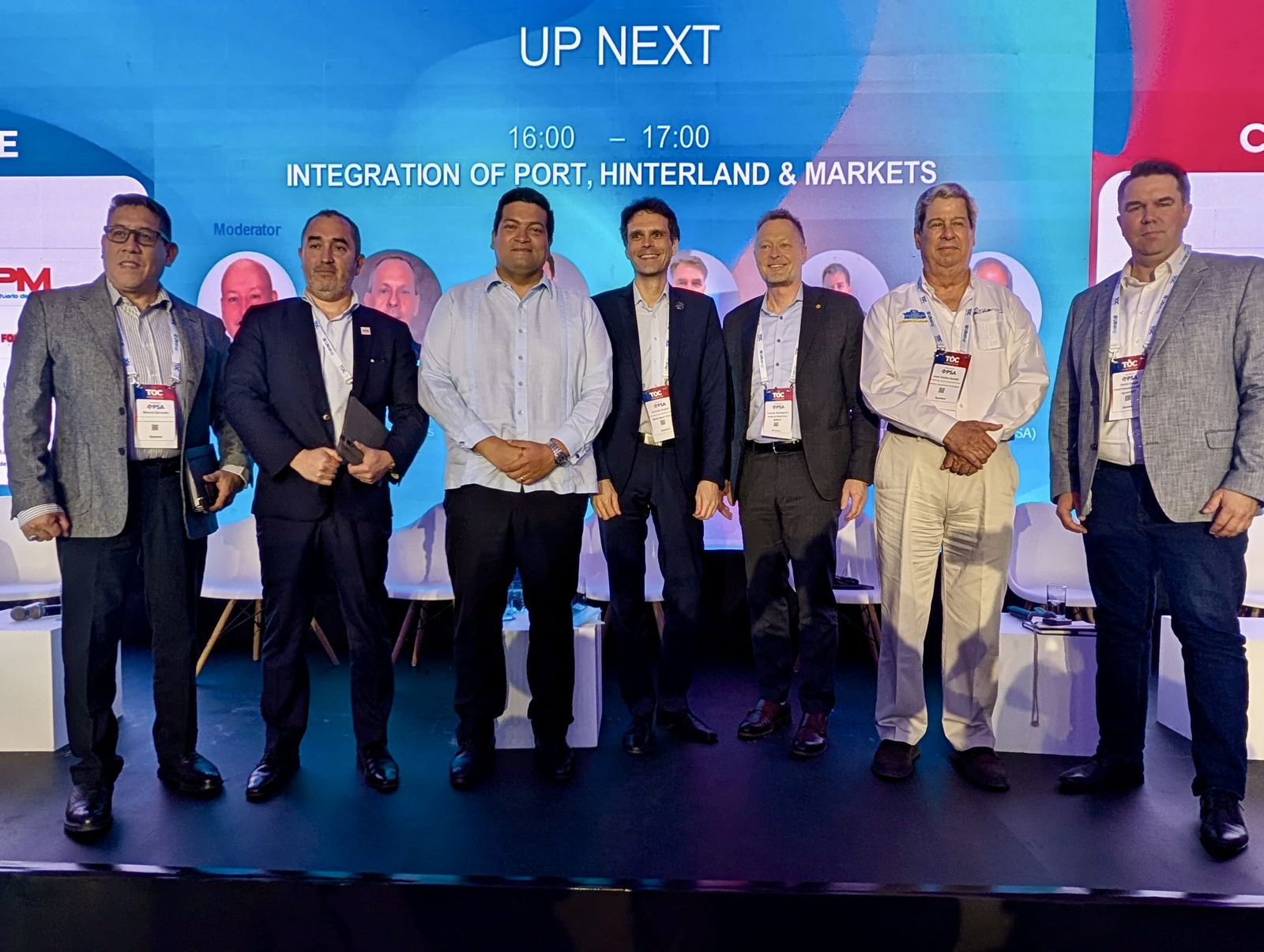
The maritime industry’s push into new fuels is stuck in a chicken-and-egg standoff between vessel owners and ports, Dominik Englert Senior Economist of the Transport Global Practice at the World Bank Group told delegates at TOC Americas in Cartagena.
“The problem is that we currently have a classical chicken and egg problem in the sector,” Englert said. Shipowners are not investing in vessels that can use new fuels at scale because ports do not provide them yet, while ports are not investing because the vessels that would demand those fuels are not out there, he said.
Englert pointed to a World Bank study of Colombia’s potential as evidence that fuel supply chains can be built around export markets, not just shipping. “We identified 7 prime investment opportunities in La Guajira, but also Barranquilla and Cartagena, to produce these fuels at relatively competitive costs… the biggest business opportunity for Colombia… is in Korea, it is in Japan, it’s in the European Union. It’s about exporting these fuels,” he said.
Rather than wait for the International Maritime Organization to settle on a single fuel, Englert argued operators should act now. “There is just… there is money lying down there, inefficiencies, and nobody picks it up for various reasons… these are no-regret options,” he said. “Start small. Start in phases, get prepared, unless there is no certainty yet what the specific fuel is going to be that is going to be needed in your port,” he added.
Thomas Damsgaard of shipowner body BIMCO cited chemical tanker operator Stolt Tankers as an example of efficiency paying off before any new fuel arrives. The company began monitoring underwater radiated noise to protect whales, he said, then found it could use the acoustic data to cut vessel noise. “By optimizing based on the acoustic models they got off the ship, they were able to optimize the noises between 2 to 3%. That is fuel safe, emission safe, and it drops straight to the bottom line,” Damsgaard said.
Container line Ocean Network Express is already hedging across several fuels while it waits, said Erick Alarcon of ONE Line Chile. “We have ordered 32 vessels of 14,000 TEU… and a smaller one of 2,000 TEU, with a small ammonia trial, which is what we will do further ahead,” Alarcon said, adding that switching to methanol requires blocking off areas on board that complicate vessel operations.
Englert told the panel ports should think of themselves differently while fuel demand builds. “We think about ports as energy clusters, as clean energy hubs for the future, where demand for new fuels gets aggregated… Tangier Med in Morocco, for instance… they are currently doing their first pilot bunkering project for methanol,” he said.