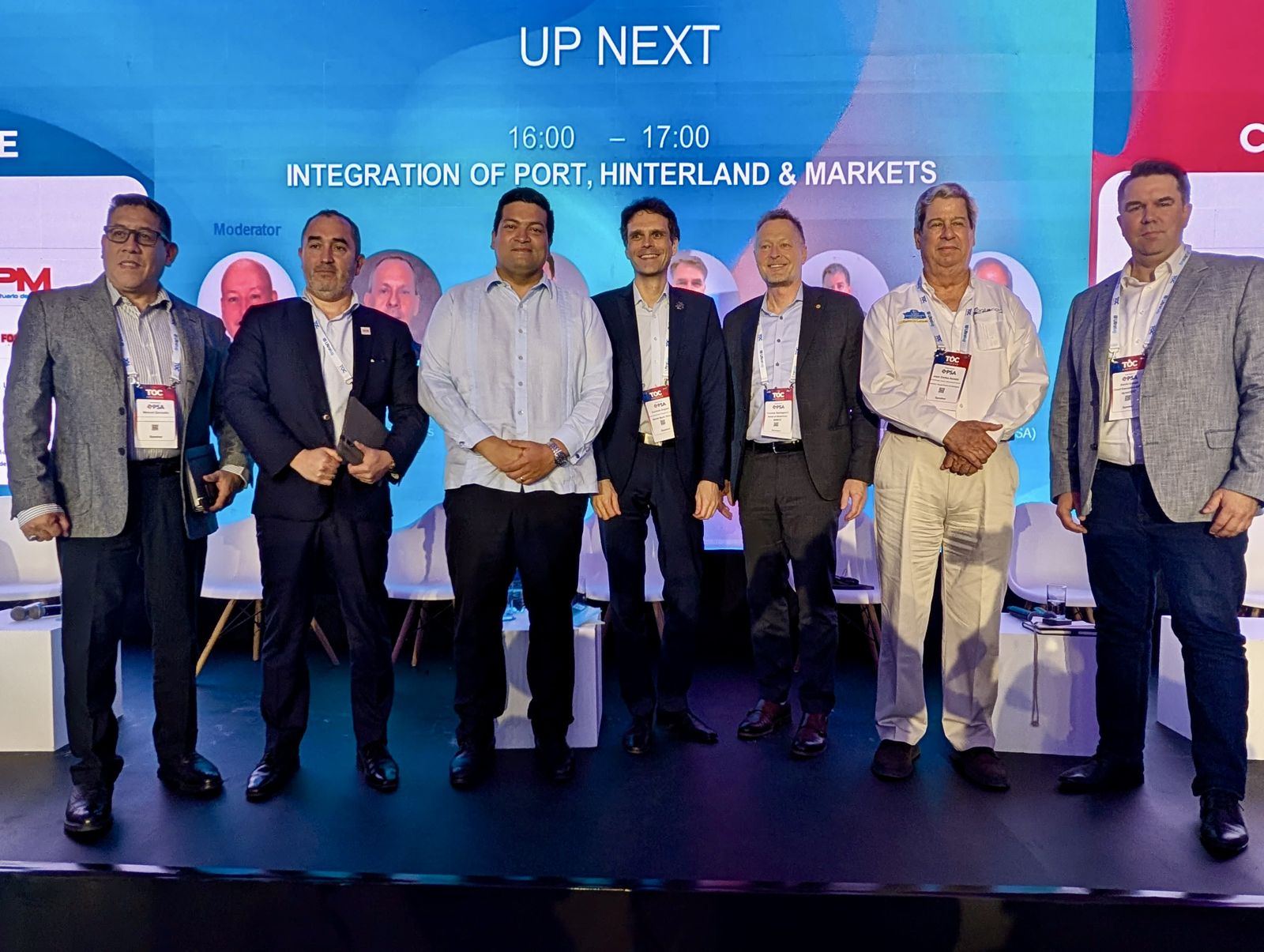
Dominik Englert of the World Bank Group told the Sustainable & Profitable Supply Chains panel in Cartagena that energy efficiency is a no-regret investment, whatever fuel eventually wins out. Five other panellists, from fuel supply to port operations, academia, engine technology and container shipping, set out their own view of where decarbonisation already pays and where it still costs money.
Dominik Englert, World Bank Group
Englert, of the World Bank Group, said energy efficiency investments are a no-regret option for ports regardless of which fuel eventually dominates, since operational gains such as just-in-time arrival are often overlooked next to big projects like green ammonia or methanol. “There is just— there is money lying down there, inefficiencies, and nobody picks it up for various reasons… these are no-regret options,” he said. Rather than wait for the International Maritime Organization to settle on a single fuel, he advised ports to build in flexibility: “Start small. Start in phases, get prepared, unless there is no certainty yet what the specific fuel is going to be that is going to be needed in your port.” A World Bank study, he said, identified seven prime investment opportunities in Colombia’s La Guajira, Barranquilla and Cartagena, with the biggest business opportunity in exports: “It’s about exporting these fuels,” he said.
Thomas Damsgaard, BIMCO
Damsgaard said BIMCO represents “about 66% of the world’s commercial fleet,” giving it a view across shipping’s different segments. He argued that decarbonisation has become “a team sport,” in which shipowners invest in technology but the return often lands with time charterers or cargo interests, and that this has to be shared given ships trade for 20 to 35 years. He pointed to Stolt Tankers, which set out to cut underwater radiated noise to protect whales and used the resulting acoustic data to fine-tune vessel performance: “By optimizing based on the acoustic models they got off the ship, they were able to optimize… between 2 to 3%.” The saving, he said, went “straight to the bottom line.” Citing BIMCO’s workforce study with the International Chamber of Shipping, he said the industry will be short 30,000 officers a year on the global fleet until 2030, and that only about 2% of seafarers are women.
Juan Carlos Acosta, Grupo Puerto de Cartagena
Acosta, of CONTECAR and Grupo Puerto de Cartagena, said the port treats sustainability as market-driven: the Gemini Alliance between Hapag-Lloyd and Maersk picked Cartagena as one of 14 global hubs, and the port has since recorded performance indicators above what the carriers had forecast. He said Cartagena is moving towards LNG as a first step in diversifying its own energy supply. “LNG ya empezamos, ya tenemos la molécula asegurada, estamos en contacto con astilleros para la construcción de las barcazas que nos sirvan para transportar esa molécula,” he said. About 15% of the port’s energy already comes from photovoltaic cells, Acosta said, and new gantry cranes due by the end of next year will be remotely operated. Training is built in-house, he added, through a 3,000m² centre with simulators used to train the entire workforce.
Manuel Zamudio, Association of Secure Companies (AES) / Universidad de La Sabana
Zamudio said the energy transition starts with decarbonisation across the whole port-city relationship, not only shipping, pointing to the International Maritime Organization’s target of a 40% cut in fleet greenhouse-gas emissions by 2030 and the rise of “Greenport” strategies at terminals. He said ports also need to cut energy consumption directly, through shore power and electrification of equipment, and that none of it works without strong governance to lead the strategy. On infrastructure, he warned that many port development plans do not yet budget for the structural and mooring changes a new fuel requires. “Todavía no hay un estándar para todos los puertos, y eso es algo que tenemos que trabajar para lograr,” he said. On training, he pointed to a joint diploma in maritime management that Universidad de La Sabana runs with the American Association of Port Authorities.
Kevin Unrath, dynaCERT
Unrath, an engine engineer at dynaCERT, said the industry now has far more mature technology available than it did 15 years ago, citing an initiative in Belgium where ageing diesel engines on inland bulk carriers are being swapped for modern Euro Stage 4 and 5 commercial-vehicle engines. He argued against betting on a single alternative fuel. “We need to be careful not to say this is the winner. Because there’s so many alternatives out there, and we should also not compare these alternatives with each other because at the end of the day, it will lead to a mix of solutions,” he said. He cited Germany’s experience with electric cars as a warning: subsidies pushed buyers before the charging network was ready, and registrations fell by up to 8% once drivers found they could not always get from A to B. On people, he said the industry needs to train staff for in-field maintenance of new fuel systems, not only development work.
Erick Alarcon, Ocean Network Express (ONE Line Chile)
Alarcon said the near-to-medium-term preference in container shipping is dual-fuel vessels running on LNG and methanol. “Hemos ordenado 32 naves, 14.000 TEU… y una más también pequeña de 2.000 y un pequeño trial de Ammonia, que es lo que van a hacer más para adelante,” he said. He said methanol bunkering is operationally more demanding than LNG, requiring blocked-off deck areas, and that crews who have already trialled it in China have faced real operational challenges. ONE’s approach, he said, is to run short trials to build up experience among crews, ports and suppliers before wider rollout. On the human side, Alarcon said the line’s main lever onshore is culture: promoting its green strategy internally, summed up in a line staff use in their email signatures. “One mission, zero emission,” he said.