
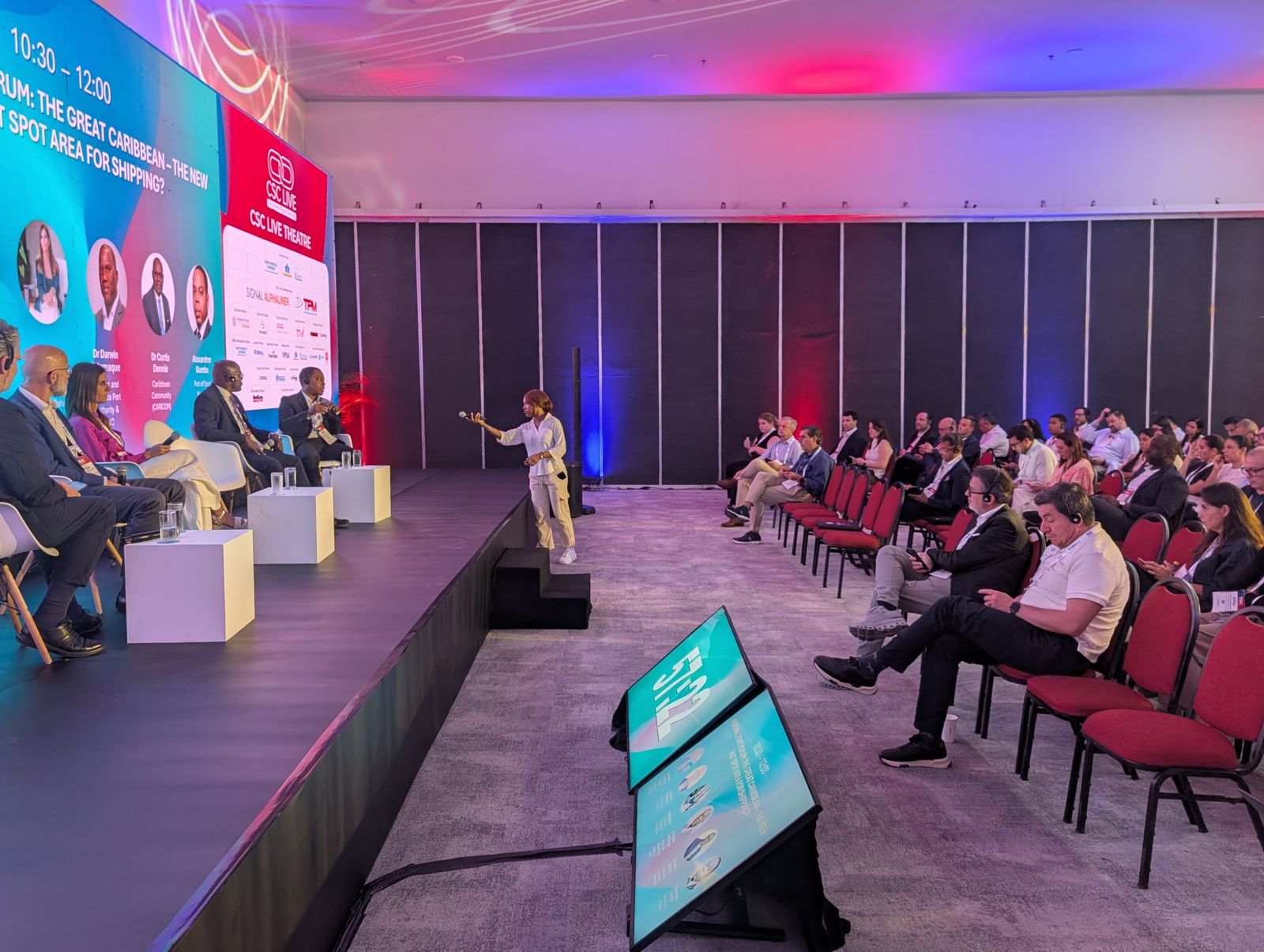
Freight costs in the Caribbean run at almost four times the global average, Dr Curtis Dennie, Maritime Specialist at the CARICOM Secretariat, told delegates at TOC Americas in Cartagena. The figure set the tone for a session that ranged from Guyana’s oil-fueled boom to small islands that import almost everything they consume.
Cristobal Schlaubitz, Tristar Port
Cristobal Schlaubitz, chief executive officer of Tristar Port in Guyana, said the country’s oil boom has produced what he called chaotic growth: Guyana now produces more than 900,000 barrels of oil a day for a population of about 900,000, with output expected to reach 1.5 million barrels a day by 2027. The country has no port able to receive large vessels directly, he said, so cargo is still transhipped through the Dominican Republic, Trinidad or Barbados; Tristar’s plan is to build a port that takes ships without transhipment and also acts as a food gateway for northern Brazil. Container volumes are projected to rise more than 30% this year, Schlaubitz said, but berth congestion and a lack of dredging are already straining the port, forcing Tristar to buy its own dredging equipment. “We are living through completely crazy, overflowing growth,” he said.
Federica Noli, Sociedad Portuaria Puerto Bahía
Federica Noli, commercial director at Sociedad Portuaria Puerto Bahía in Cartagena, said Colombia’s Caribbean coast runs 1,600km from the border with Panama to the border with Venezuela, hosting container, oil, bulk, livestock and cruise terminals along a single stretch of multiple-purpose cargo. Puerto Bahía’s bay is sheltered from wind and tide, she said, letting it operate 365 days a year, while Colombian ports are expecting 17% growth in container volumes this year. But growth, she argued, should not disguise inefficiency: congestion in Cartagena often starts not inside the terminal but at gates, support yards and onward transport, driving repeated handling of the same cargo and higher costs for customers. “We cannot grow to make up for the inefficiency in transport … we also have to see how we solve the logistics issues,” she said.
Alexander Gumbs, Port of St. Maarten
Alexander Gumbs, Chief Executive Officer at Port of St. Maarten described the island as a 37-square-mile island of 80,000 residents acting as a sub-hub for nine neighbouring islands’ transshipment, food and diesel needs, alongside a cruise business expecting 1.8 million passengers this year. More than 95% of the island’s economy depends on tourism, he said, leaving the port highly reliant on imports and on its relationships with equipment suppliers when something fails far from home. “We may have a contact in the US that may have that part in stock as a spare, and you can kind of do a trade,” he said.
Dr Curtis Dennie, CARICOM
Dr Curtis Dennie, Maritime Specialist at the CARICOM Secretariat, said freight costs in the Caribbean sit at almost four times the global average, with around 90% of the region’s imports arriving by sea, a dependency he said leaves island economies exposed to tariff rises, fuel surcharges and general rate increases. CARICOM is pushing a regional ferry initiative, agreed by the bloc’s heads of government in St Lucia last July, to move people, agricultural goods and food-security supplies between islands that lack direct shipping links. Pointing to repeated studies on the region’s skills and infrastructure gaps, Dennie argued the Caribbean needs action rather than analysis: “We don’t need another study in the Caribbean. The solutions are there,” he said.