
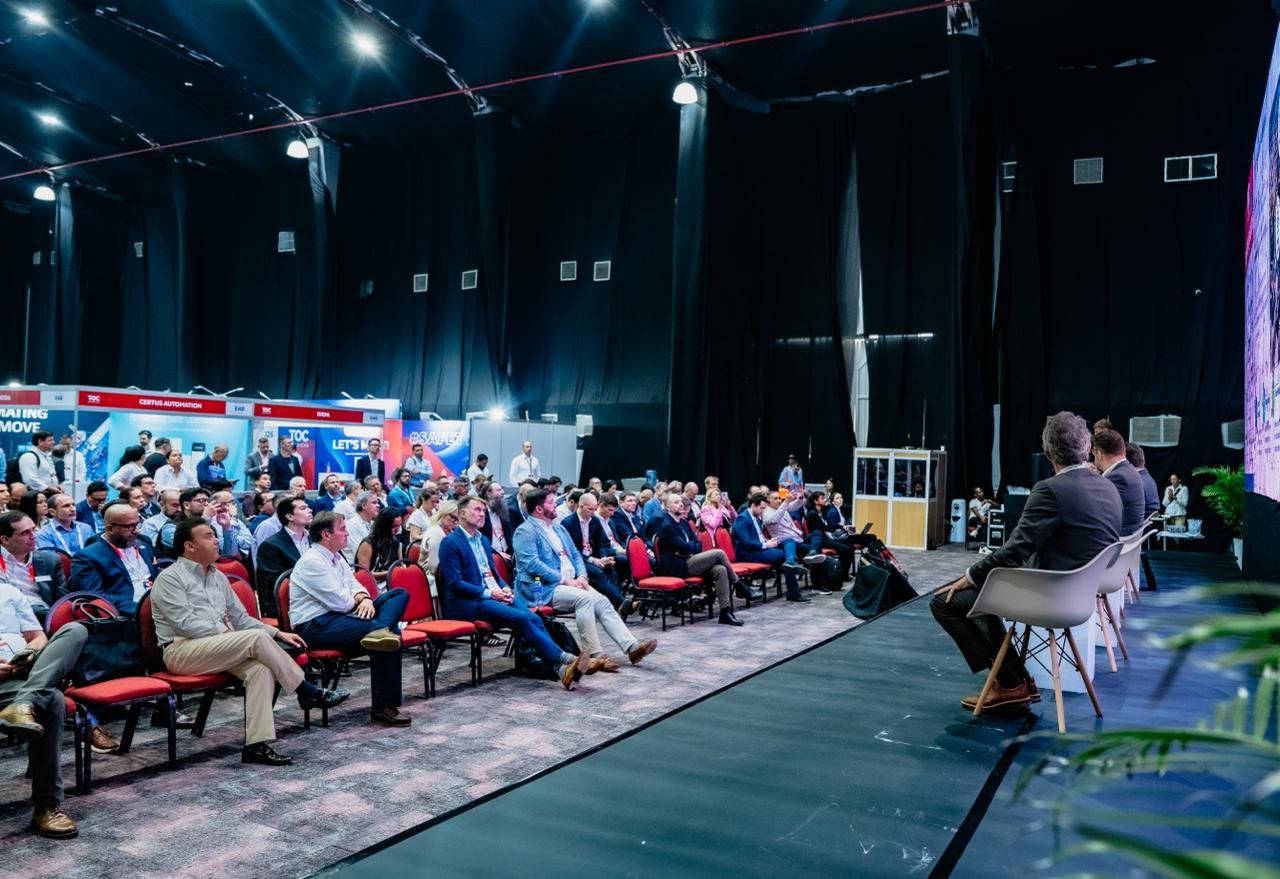
TOC Americas 2026 · Day 1 highlights
Tuesday 20 October · Cartagena
Day 1 of TOC Americas 2026 in Cartagena: 6 stories from CSC LIVE.
When crisis hits, people decide, say six supply chain leaders
Elsa Muñoz of AliExpress (Alibaba Group) told delegates at TOC Americas in Cartagena that delivery speed depends on the market, with consolidation and the choice between air and sea freight adding time even as platforms compete on cost and resilience. Carlos Palacios, GEODIS Colombia, said ocean freight rates rose from $2,000 to $9,000 per container during a recent squeeze on space from the Far East, before settling near $6,500. Hapag-Lloyd’s Fernando Alarcón argued artificial intelligence can run crisis scenarios but should never make the final call: “Technology is going to help us. But that’s what we are for: the people.”
CSC LIVE · Read more
Colombia ties port concessions to performance, says GPC’s Salas
Alfonso Salas of Grupo Puerto de Cartagena (GPC) told delegates at the opening of TOC Americas in Cartagena that Colombia’s new port modernisation decree extends terminal concessions but ties the extensions to sustained performance standards. GPC expects to move a little more than 5 million containers this year, Salas said, marking the port’s third hosting of the event since 2014. He argued that volume alone was the wrong yardstick for success: “A port should not be measured only by the number of containers it moves.”
CSC LIVE · Read more
People, then AI: two views on competing beyond the quay
Giovanni Benedetti, commercial lead at Grupo Puerto de Cartagena (GPC), told delegates at TOC Americas that disruption has become constant across shipping and ports, from tariffs to climate to Middle East risk, and that competitiveness will increasingly depend on artificial intelligence rather than infrastructure alone. He said ocean carrier schedule reliability now stands at just 27%, and cited US President Trump’s estimate that keeping the Strait of Hormuz open would cost $2m a day. GPC’s head of talent, Karina Kure, argued the real challenge is organisational, building people who can decide with incomplete information rather than chase perfect forecasts: “We can’t control uncertainty, but we can control how we prepare to navigate it.”
CSC LIVE · Read more
Uncertainty and resilience: five views on the 2026 trade outlook
Dinesh Sharma, director at Drewry Maritime Advisory, told a TOC Americas panel that global laden cargo volumes remain about 10% below where pre-disruption trends suggested they would be by 2026. Natalia Gil of Grupo Puerto de Cartagena said a study of regional shipping found that carriers change a route or service on average every 3.9 days, making flexibility as important as capacity. Henry Ziemer of CSIS warned that growing strategic interest in the region’s ports cuts both ways: “Who controls ports and maritime infrastructure matters now more than ever.”
CSC LIVE · Read more
Flexibility, not forecasting, wins in Latin America shipping, says PIL's Romero
Nicolas Romero, head of Latin America for Pacific International Lines (PIL), told TOC Americas that globalisation remains strong despite tariff turmoil, and that carriers able to build flexibility into their fleets are best placed to profit from the region’s volatility. Over the past two decades PIL has cut vessel speeds by about two knots to reduce fuel consumption, he said, while continuing to invest in new technologies such as bulbous bows and alternative fuels. The bigger challenge, he argued, is that Latin America’s port capacity cannot keep pace with the volumes on order: “there is a mismatch, that the demand will remain above the capacity.”
CSC LIVE · Read more
Tariff swings jolt Cartagena cargo, but no lasting shift, says Benedetti
Giovanni Benedetti of Grupo Puerto de Cartagena (GPC) told TOC Americas that tariff announcements from the United States caused sharp, short-lived swings in cargo through the port, not a lasting shift. Transhipment from Brazil saw a sudden inflow then a sharp drop after Washington announced tariffs on Brazilian goods, Benedetti said, while a tariff Ecuador placed on Colombian goods briefly cut exports before flows resumed. Karina Kure of GPC and Delta X said the volatility has pushed the port to build a more resilient workforce, with Benedetti summing up the pattern: “It's incredible that a single word generates reactions in trade flows so quickly and so significantly.”
CSC LIVE · Read more
Tomorrow: Interview: Tom van Eynde, TiL Group (CSC LIVE, ) · Dry bulk (TECH TOC, 10:30)